You are the engagement partner on the audit of Uchenna & Associates. The audit senior sent you the schedule of uncorrected misstatements, shown below, including notes to explain each matter in the schedule. Profit or loss Statement of financial position is as follows:
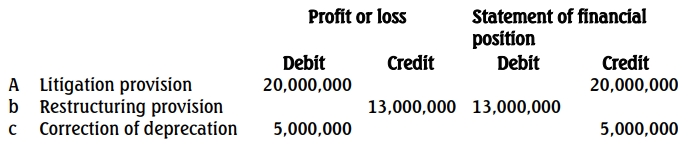
The audited financial statements recognized revenue of N250 million and total assets of N1.24 billion. The materiality threshold was determined as N12.5 million.

You are holding a meeting with management tomorrow, at which the uncorrected misstatements will be discussed.

Notes:

  1. Litigation Provision: Uchenna & Associates was involved in a dispute over goods quality, resulting in a court judgment against them for N20 million. Uchenna & Associates has appealed the judgment, and its solicitors are confident of a favorable outcome. Management has not recognized the provision, believing they are likely to win. The audit conclusion is that a provision should be included in the financial statements.
  2. Restructuring Provision: Management recognized a provision for closing one of its factories. Although the board approved the closure in April 2019, no employee announcements were made. The audit conclusion is that the provision should not be recognized.
  3. Depreciation Correction: The audit team’s recomputation identified an understatement of N5,000,000 in depreciation expense.

Required:
a. Explain the requirements of ISA 450: Evaluation of Misstatements Identified during the Audit, with regard to uncorrected audit misstatements. (15 Marks)
b. Discuss the matters to be addressed with management for each uncorrected misstatement. (5 Marks)

1a. Requirements of ISA 450 for Uncorrected Misstatements:

  • Assessment of Misstatements: ISA 450 requires the auditor to accumulate misstatements identified during the audit, except those that are clearly trivial.
  • Evaluation of Materiality: The auditor must evaluate whether uncorrected misstatements, individually or in aggregate, could be material to the financial statements.
  • Consideration of Qualitative Factors: Even if the misstatements are below the materiality threshold, qualitative factors such as the nature of the misstatements or the circumstances may cause them to be material.
  • Impact on Financial Statements: The auditor should assess how the misstatements affect the true and fair view of the financial statements, especially for items like provisions, which may affect users’ perception.
  • Communication with Management: The auditor must communicate uncorrected misstatements with management, explaining their nature and potential impact.
  • Documentation: The auditor is required to document the accumulated misstatements, their evaluation, and the final conclusion on whether the misstatements are material.

1b. Matters to Discuss with Management:

  • Litigation Provision: The auditor should explain the need for a provision based on the court judgment and discuss the potential impact if the appeal is unsuccessful.
  • Restructuring Provision: Management should be advised that, without formal announcements, the provision may not meet recognition criteria under IAS 37.
  • Depreciation Correction: The auditor should discuss the understatement of depreciation, highlighting how correcting it improves accuracy and compliance with IAS 16.