- 20 Marks
Question
Peter John plc (PJP) is considering a takeover bid for Yekin plc (YP).
PJP’s board of directors has issued the following statement:
“Our superior P/E ratio and synergistic effects of the acquisition will lead to a post-acquisition increase in earnings per share and in the combined market value of the companies.”
Summarized financial data for the companies (N Million):
| PJP | YP | |
|---|---|---|
| Sales | 480.0 | 353.0 |
| Profit before tax | 63.0 | 41.0 |
| Tax | (18.9) | (12.3) |
| Profit after tax | 44.1 | 28.7 |
| Dividends | 20.0 | 11.0 |
| Non-current assets (net) | 284.0 | 265.0 |
| Current assets | 226.4 | 173.0 |
| Total assets | 510.4 | 438.0 |
Equity and Liabilities:
| PJP | YP | |
|---|---|---|
| Ordinary shares (10 kobo par value) | 40.0 | 30.0 |
| Reserves | 211.2 | 192.0 |
| Medium and long-term borrowing | 86.0 | 114.0 |
| Current liabilities | 173.2 | 102.0 |
| Total | 510.4 | 438.0 |
Notes:
- After-tax savings in cash operating costs of N7,500,000 per year indefinitely are expected as a result of the acquisition.
- Initial redundancy costs will be ₦10 million before tax.
- PJP’s cost of capital is 12%.
- Current share prices: PJP = N29, YP = N18.
- The proposed terms of the takeover are payment of 2 PJP shares for every 3 YP shares.
Required:
a. Calculate the current P/E ratios of PJP and YP. (2 Marks)
b. Estimate the expected post-acquisition earnings per share and comment upon the importance of increasing the earnings per share. (4 Marks)
c. Estimate the effect on the combined market value as a result of the takeover using:
i. P/E-based valuation
ii. Cash flow-based valuation
State clearly any assumptions that you make. (5 Marks)
d. Discuss the limitations of your estimates in (c) above. (3 Marks)
e. Evaluate the strategic implications of making a hostile bid for a company compared with an aggressive investment program of organic growth. (6 Marks)
Answer
a) PJP currently has 400 million ordinary shares, and Fader 300 million.
Earnings per share:
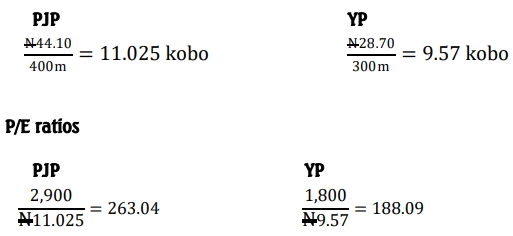
b) A 2-for-3 share exchange will result in the issue of 300 million x 2/3 new shares, or 200 million shares, giving a total of 600 million shares.
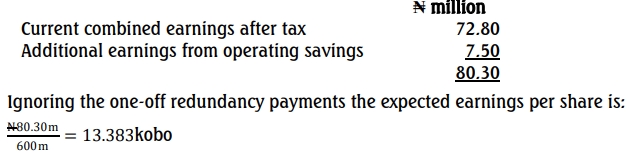
Increasing earnings per share alone is not enough. The effect on the market value is the crucial factor. When a relatively high P/E company acquires a company with a lower P/E, the expected earnings per share will increase, but not necessarily the total market value of the companies.
c) i) The current combined value of the two companies is:
(400m shares x ₦29) + (300m shares x ₦18) = ₦17 billion.
If the market is efficient, ignoring any synergistic or other effects of the
takeover, the post-acquisition P/E will be the weighted average (by earnings) of the current P/E ratios.
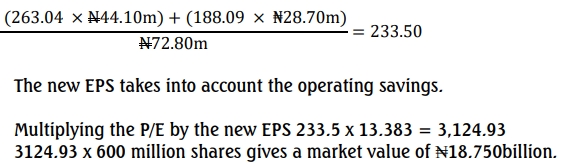
However, this ignores the impact of the redundancy costs, ₦7,000,000 after tax.
When this is included the combined value of the companies is still expected to substantially increase.
ii) Changes in expected cash flows as a result of the takeover are as follows:

If the market is efficient the market value of the combined company should increase by ₦55,500,000 as a result of the expected increase in NPV, much less than the estimate using P/E based valuation.
d. Limitations of Estimates:
- P/E ratios may not accurately capture post-acquisition integration issues.
- Cash flow assumptions assume perpetual savings without variability.
- Market sentiment and risk factors influencing share prices are not fully captured.
e. Strategic Implications of a Hostile Bid:
- Hostile Takeover: May lead to resistance from YP’s management, negatively impacting morale and integration efficiency. Risk of overpayment due to premium.
- Organic Growth: Although slower, it allows for strategic control and reduces the risks associated with forced integration. Organic growth can also maintain positive stakeholder relations and a stable corporate culture.
- Tags: Market Value, P/E Ratio, post-acquisition EPS, Synergy, takeover strategy, Valuation Techniques
- Level: Level 3
- Topic: Mergers and acquisitions
- Uploader: Kofi