Kehinde is a wholesaler who buys and sells a wide range of products, including electrical component TK. Kehinde sells 24,000 units of TK each year at a unit price of N2,000. Sales of TK normally follow an even pattern throughout the year. To prevent stock-outs, Kehinde keeps a minimum inventory of 1,000 units. Further supplies of TK are ordered whenever the inventory falls to this minimum level, and the time lag between ordering and delivery is small and can be ignored.

At present, Kehinde buys all his supplies of TK from Ajoke Limited and usually purchases them in batches of 5,000 units. His most recent invoice from Ajoke Limited was as follows:

Item Amount (N’000)
Basic price: 5,000 units of TK at N1,500 per unit 7,500
Delivery charges:
– Transport at N50 per unit 250
– Fixed shipment charge per order 100
Total 7,850

Kehinde also estimates an ordering cost of N50,000 per order, comprising administrative costs and sample checks, which does not vary with the order size.

Kehinde stores TK in a warehouse rented at N500 per square metre per annum, with excess capacity sublet at N400 per square metre annually. Each unit of TK in inventory requires 2 square metres of space. Other holding costs are estimated at N1,000 per unit per annum.

Kehinde has recently learned that another supplier, Ema Limited, offers discounts for large orders. Ema Limited’s pricing structure is as follows:

Order Size Price per unit (N)
1 – 2,999 1,525
3,000 – 4,999 1,450
5,000 and over 1,425

In other respects (delivery charges and order lead time), Ema Limited’s terms match those of Ajoke Limited.


Required:

a. Calculate the relevant:
i. Cost per order
ii. Holding cost per unit per annum (4 Marks)

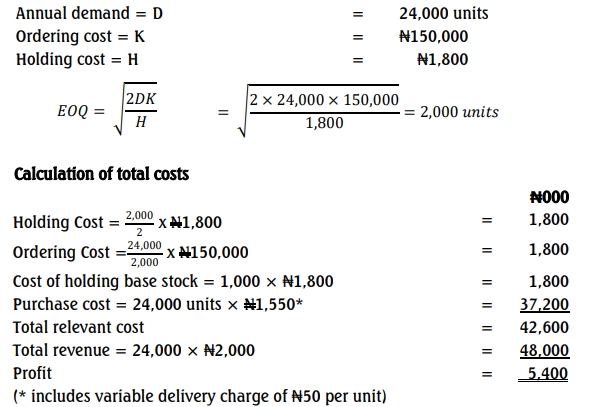
b. Irrespective of your answers in (a) above and assuming a cost per order of N150,000 and holding cost per unit per annum of N1,800, calculate the optimal re-order quantity for TK and the associated annual profit Kehinde can expect from the purchase and sale, assuming that he continues to buy from Ajoke Limited. (6 Marks)

c. Prepare calculations to determine if Kehinde should buy TK from Ema Limited instead of Ajoke Limited, and in what batch size. (7 Marks)

d. Discuss the key limitations of the method of analysis you used. (3 Marks)

a. Relevant Costs Calculation

i. Cost per Order

  • Fixed shipment charge: ₦100,000
  • Administrative cost: ₦50,000
  • Total Cost per Order: ₦150,000

ii. Holding Cost per Unit per Annum

  • Opportunity cost of warehousing space = 2 sqm × ₦400 = ₦800
  • Other holding costs = ₦1,000
  • Total Holding Cost per Unit per Annum: ₦1,800

b. Calculation of EOQ and Expected Profit

  • EOQ Calculation

c. Evaluation of Quantity Discount

  • ROQ Evaluation
    ROQ Purchase Price per Unit (₦) Holding Cost (₦’000) Ordering Cost (₦’000) Base Stock Holding Cost (₦’000) Purchase Cost (₦’000) Total Cost (₦’000)
    2,000 1,550 1,800 1,800 1,800 37,200 42,600
    3,000 1,500 2,700 1,200 1,800 36,000 41,700
    5,000 1,475 4,500 720 1,800 35,400 42,420
  • Recommendation: Kehinde should purchase in batches of 3,000 from Ema Limited to minimize costs.

d. Limitations of Analysis

  1. The model assumes constant annual demand with predictable usage throughout the year.
  2. Estimating the relevant incremental order cost per unit is challenging, as most order costs are semi-fixed.
  3. Order costs are assumed to remain constant, irrespective of order size.
  4. Estimating some holding costs, like materials handling and obsolescence, is difficult.
online
Knowsia AI Assistant

Conversations

Knowsia AI Assistant