Enugun Industries Limited
Atikun has recently been appointed as Financial Controller to Enugun Industries Limited. Until a month ago, Enugun Industries had a Finance Director, who resigned suddenly, due to ill health. Since Atikun joined the company, he has learned that his resignation was related to stress caused by a series of disagreements with the Managing Director about the performance of the business. The directors have not yet appointed a replacement.

It is now March 2015, and you have been asked to finalize the financial statements for the year ended December 31, 2014. The draft statement of profit or loss extract and statement of financial position are shown below:

Draft statement of profit or loss for the year ended December 31, 2014:

Profit before tax ₦’000
2,500

Draft statement of financial position as of December 31, 2014:

Item Amount (₦’000)
Property, plant, and equipment 12,000
Current assets 3,500
Total assets 15,500
Share capital 2,000
Retained earnings 6,000
Equity 8,000
Non-current liabilities 5,000
Current liabilities 2,500
Total equity and liabilities 15,500

During the year ended December 31, 2014, Enugun Industries entered into the following transactions:

  1. Just before the year-end, Enugun Industries signed a contract to deliver consultancy services for a period of 2 years at a fee of ₦500,000 per annum. The full amount of this fee has been paid in advance and is non-refundable.
  2. Enugun Industries has constructed a new factory. The construction has been financed from the pool of existing borrowings. Land at a cost of ₦1.8 million was acquired on February 1, 2014, and construction began on June 1, 2014. Construction was completed on September 30, 2014, at an additional cost of ₦2.7 million. Although the factory was usable from that date, full production did not commence until December 1, 2014. Throughout the year, the company’s average borrowings were as follows:
    Borrowing Type Amount (₦) Annual Interest Rate (%)
    Bank overdraft 1,000,000 9.75
    Bank loan 1,750,000 10
    Loan notes 2,500,000 8

    An amount of ₦450,000 has been included in property, plant, and equipment in respect of borrowing costs relating to the construction of the factory. The useful life of the factory has been estimated at 20 years. No depreciation has been charged for the year. The reason for this is that the factory has only been in use for one month and that the depreciation charge would be immaterial.

  3. A blast furnace with a carrying amount at January 1, 2014, of ₦3.5 million has been depreciated in the draft financial statements based on a remaining life of 20 years. In December 2014, the directors carried out a review of the useful lives of various significant items of plant and machinery, including the blast furnace. They concluded that the furnace’s useful life was 20 years as of December 31, 2014. The reasoning behind this judgment was that the lining of the furnace had been replaced in the last week of December 2014 at a cost of ₦1.4 million. Provided that the lining is replaced every five years, the life of the furnace can be extended accordingly. You have found a report commissioned by the previous Finance Director and prepared by a firm of asset valuation specialists, which assesses the remaining useful life of the main structure of the furnace as 15 years at January 1, 2014, and the lining of the furnace as 5 years. You have also found evidence that the Managing Director has seen this report.

Atikun has had a conversation with the Managing Director, who told him, “We need to make the figures look as good as possible, so I hope you’re not going to start being difficult. The consultancy fee is non-refundable, so there’s no reason why we can’t include it in full. I think we should look at our depreciation policies. We’re writing off our assets over far too short a period. As you know, we’re planning to go for a stock market listing in the near future, and being prudent and playing safe won’t help us do that. It won’t help your future with this company either.”

Required:

  1. Explain the required IFRS accounting treatment of these issues, preparing relevant calculations where appropriate.
    (16 Marks)
  2. Discuss the ethical issues arising from your review of the draft financial statements and the actions that you should consider.
    (4 Marks)

Total: 20 Marks

Scenario I: Revenue Recognition for Consultancy Contract
For revenue to be recognized, the following criteria must be satisfied:

  • The entity has transferred to the buyer the significant risks and rewards of ownership.
  • The revenue amount can be measured reliably.
  • The incurred cost can be measured reliably.
  • The transaction’s stage of completion at the reporting date can be measured reliably.

Since these criteria are not met for the consultancy contract, the full amount of ₦1,000,000 should be recognized as liability or non-current liability rather than as revenue.

Scenario II: Borrowing Costs for Factory Construction
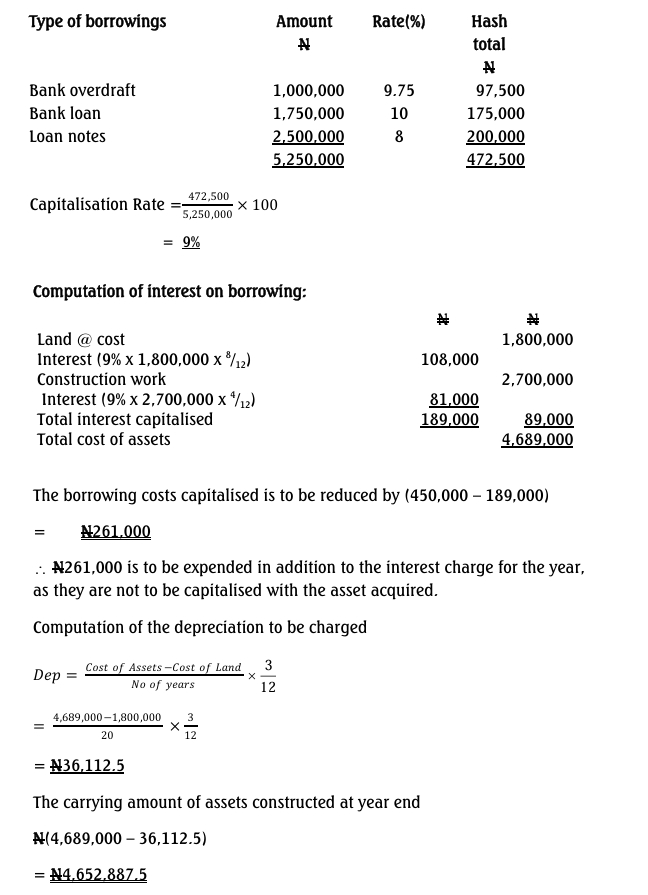
Borrowing costs directly attributable to constructing an asset requiring an extended period to become operational should be capitalized as part of the asset’s cost. For general borrowings, the capitalization amount is based on the weighted average cost of borrowing.

  • Capitalization Rate Calculation:

Scenario III: Depreciation of Blast Furnace
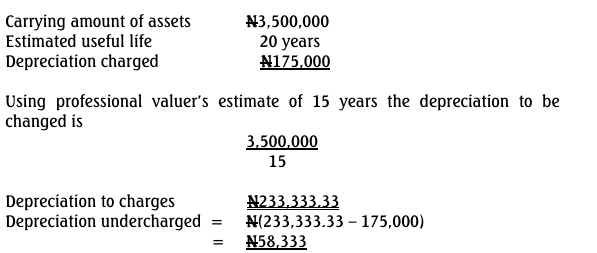
The depreciation of the blast furnace was based on a 20-year useful life, contrary to a report by a qualified expert recommending 15 years.

  • Depreciation Calculation Based on Valuer’s Estimate
Revised Financial Statements
Statement of Profit or Loss Extract for the Year Ended December 31, 2014:

Item ₦’000
Profit Before Tax 2,500
Less: Consultancy Agreement (1,000)
Overcapitalized Interest (261)
Undercharged Depreciation (58.33)
Revised Profit 2,180.67

Statement of Financial Position as of December 31, 2014:

Item Adjustment (₦’000) Revised Amount (₦’000)
Property, Plant, Equipment (319.33) 11,680.67
Current Assets 3,500
Total Assets 15,181
Share Capital 2,000
Retained Earnings (1,319.33) 4,680.67
Equity 6,681
Non-Current Liabilities 500 5,500
Current Liabilities 500 3,000
Total Equity and Liabilities 15,181

Ethical Issues
The following are ethical concerns:

  • Pressure on the previous Financial Controller to compute depreciation with an extended useful life, possibly leading to the resignation.
  • The Managing Director’s pressure to present favorable financial statements for a potential stock listing.
  • Threats regarding the Financial Controller’s future for non-compliance.

Possible Courses of Action for Financial Controller:

  1. Discuss compliance with IFRS standards with the MD.
  2. Emphasize adherence to professional ethical standards.
  3. Consider consulting with other directors or the audit committee.
  4. As a last recourse, resign to maintain professional integrity.
online
Knowsia AI Assistant

Conversations

Knowsia AI Assistant